Monolev SCIP Is the
Construction System
The World Has Been Waiting For.
A new construction system is solving the biggest problems in the industry — labor shortages, climate disasters, rising costs, and slow timelines. Monolev SCIP outperforms Stick-Frame, ICF, and CMU in every measurable category. With 4 people, you erect the walls of a 1,300 sq ft house in a single day.
You've Never Seen a Wall
Built Like This Before.
One construction system replaces stick-frame, ICF, and CMU — delivering complete buildings faster, with fewer people, and with performance no conventional system can match. Watch it build a complete structure before you decide anything.
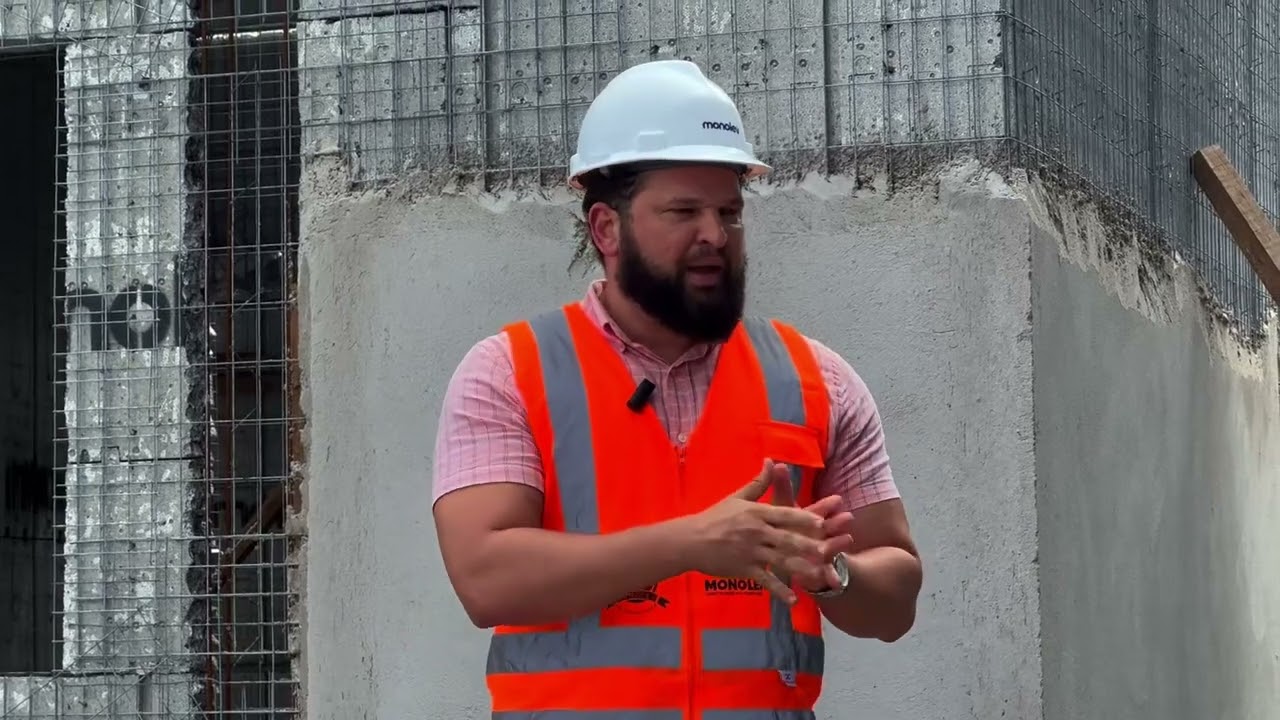
High-tensile galvanized steel wire machine-welded at 240+ intersection points per panel. Superior to the steel used in conventional beams and columns. Creates a continuously rigid diaphragm on both faces — distributing every load across the entire wall plane. No weak points.
Expanded polystyrene core delivers continuous insulation with no thermal bridging — uniform from floor to ceiling in any climate. Also contributes STC 40 acoustic separation and weighs only 28.6 lbs per panel. One worker handles it in any terrain.
Structural concrete projected to both faces on-site. At full cure: 3,600 PSI compressive strength, 55 short tons of vertical load per panel, and 4-hour fire resistance. The shotcrete is what transforms the assembly into a single monolithic structure — no joints, no separation between layers.
Stick-Frame, ICF, and CMU
Were Not Built for This World.
Stick-frame (2×6 wood framing) is the standard in 90% of American homes. ICF (Insulated Concrete Form) helps with insulation but is slow and expensive. CMU (Concrete Masonry Unit) adds dead load without performance. None of them were engineered for today's climate, today's labor shortage, or today's energy codes — and none of them build a complete structure as fast, as safe, or with as few workers as Monolev SCIP.
Burns at 572°F. Fails at 110 mph winds. Delivers R-6 effective insulation (not R-19). Zero ballistic resistance. Requires 15–20 workers and 6 months. The most common wall in America is also the most vulnerable.
→ Monolev: 200+ mph · 4-hr fire · 4 people · 37 daysICF delivers good thermal but requires complex formwork, heavy concrete pours, and skilled crews. CMU adds structural load without insulation (R-2). Neither delivers hurricane, fire, seismic, ballistic, and acoustic performance together.
→ Monolev does all six in one panel, one day88% of US contractors can't find skilled workers. Every conventional system still demands large specialized crews. The workforce isn't there — and the systems haven't adapted.
→ Monolev: 4 people erect a 1,300 sq ft house in 1 dayOne System. Complete Buildings.
Faster, Stronger, With Fewer People.
Houses. Multi-story buildings. Commercial developments. Public infrastructure. Monolev SCIP is a complete construction system — not a specialty product. It builds everything conventional construction builds, in less time, with fewer workers, and with performance no stick-frame, ICF, or CMU structure can match.
Monolithic steel-concrete panel creates a continuous load path — no joints, no pull-through failures, no shear plane failures. Stick-frame fails at 110 mph. This doesn't.
No wood. No combustible foam. No OSB. The panel doesn't burn and doesn't release toxic gas or smoke. Safe enough to build a fireplace inside a Monolev structure.
240+ electro-welded connection pins distribute seismic energy across the entire diaphragm — eliminating the point failures that collapse wood-frame buildings in Zone 4 events.
Steel mesh + 3,600 PSI concrete stops high-caliber projectiles — including .357 Magnum and .44 Magnum. Stick-frame offers zero ballistic resistance. Monolev turns your structure into a fortress.
EPS core delivers continuous insulation with zero thermal bridging — uniform from floor to ceiling. 2×6 framing delivers R-6 effective (not R-19). Monolev cuts HVAC load by up to 40%.
STC 40 certified. In multifamily, hospitality, and commercial construction, what happens in one unit is completely inaudible in the next. Standard stud walls deliver STC 33.
Conventional Construction vs. Monolev SCIP
Every Category. Every Project Type.
—
Fire
—
Ballistic
—
Thermal
—
Acoustic
—
Speed
—
Weight
Tested in the Field.
Proven Under Real Load.
Monolev SCIP hasn't just been tested in controlled conditions. It's been deployed in real construction projects — under real structural loads, in real conditions — and delivered.
A 3-story structure built entirely with Monolev SCIP panels — without interior columns or structural beams. Every floor load transferred through the monolithic structure alone — no beams, no columns.
Multi-Story · No Interior ColumnsA 7-story residential building executed by Construtora Canal using the Monolev system as the primary structural wall assembly. Real load. Real floors. Real occupants.
7 Stories · Full Structural LoadA large-scale public venue for Vale do Rio Doce built with the Monolev system — demonstrating performance at scale, in a high-footfall, acoustically-demanding environment.
Large Scale · Public Infrastructure
The System Is Only as Fast
as the Team That Knows It.
These numbers are real — but they only happen when the system is installed correctly. Wrong shotcrete mix. Incorrect connection sequence. Improper curing. These aren't hypotheticals — they're the field errors ISOCIL engineers see every month on job sites where someone "figured it out."
Foundation to finish — every step, every connection detail, every tolerance. The way the manufacturer builds it on 32,000+ projects per year with ISOCIL products.
The most common failure point in SCIP construction. Wrong mix ratios kill compressive strength. This course teaches exact proportions, application technique, and how to verify the 3,600 PSI result.
ASTM test summaries and IBC compliance documentation — formatted and ready for building department submittal. Stop explaining the system from scratch every time.
Three Reasons to Learn
One System.
4 workers. 37 days. A finished building that survives Category 5 hurricanes, 4-hour fires, and earthquakes — at a fraction of the conventional crew size and timeline.
- Cut crew from 15–20 to 4 workers
- Cut timeline from 6 months to 37 days
- Win projects your competitors can't staff
- Charge a premium — and justify every dollar
One wall assembly. Hurricane, seismic, fire, ballistic, thermal, and acoustic — all in one system, all in one specification. Qualify for projects no other wall can serve.
- IBC 2021 / IRC 2021 / ASCE 7-22 compliant
- Full documentation package for permit submittal
- LEED v4 EA credit eligible
- Spec it once. It handles every performance demand.
Construction firms that adopt Monolev SCIP as a standard system reduce timeline, crew size, and material cost — while unlocking project types that wood-frame can never deliver.
- Train entire crews to manufacturer's standard
- Access ISOCIL engineers directly
- First-mover advantage in your market
- Enterprise session available — $3,000
From "What Is SCIP?" to
"I Can Build This Anywhere."
7 modules. 80+ lessons. Built by the engineers who manufacture the panel and have deployed it in real projects across three continents. No prior SCIP experience required.
- How Monolev SCIP works vs. stick-frame, ICF, and CMU
- Identifying certified panels vs. imitations
- IBC / IRC / ASCE 7-22 code overview
- Required equipment for each installation phase
- Structural shotcrete mix — exact proportions
- Compatible materials and approved suppliers
- Foundation sizing for 58% reduced dead load
- Slab-on-grade execution and compaction
- Base preparation for panel installation
- Correct panel erection sequence and bracing
- MEP rough-in — plumbing and electrical
- Panel modulation for maximum efficiency
- Swimming pool construction with SCIP
- Double-height construction and execution
- Special structural configurations
- Deck anchorage to SCIP bearing walls
- Parapet and eave detailing
- Correct shotcrete application technique
- Achieving 3,600 PSI — verified 28-day cure
- Finish preparation — no rework
Included With Every Enrollment
Spreadsheet for accurate panel counts — use it directly on site.
12-month access to a closed network of ISOCIL-trained professionals.
Submit technical questions to ISOCIL engineers during active projects.
ASTM summaries and IBC compliance letters for AHJ submittal.
You're Learning From
The Engineers Who Built It.
Eng. Marano, Eng. Igor, and Eng. Rafael don't teach from textbooks. They teach from real projects, real failures, and the field experience of deploying this system at scale.
16+ years with the Monolev system. Supervised 200+ SCIP projects. Teaches the field errors that books can't cover — so you don't pay to learn them on your client's project.
Construction planning, panel modulation, and lean crew management. His methodology consistently delivers SCIP projects in 37 working days with 4-person crews.
Structural shotcrete application and quality control. The module most practitioners cite as the difference between passing and failing field inspection.
They Didn't Know SCIP Either.
Here's What Happened.
I've studied several modern construction systems. Monolev SCIP is, without question, the most complete one I've encountered. The training gave me the technical depth to specify it with full confidence on my next project.

As a structural engineer, I needed real technical backing — not marketing claims. ISOCIL's training is the only program with genuine test data, installation specificity, and documentation that holds up in plan review.

The swimming pool and double-height modules opened applications I didn't think were possible with a panel system. This training directly expanded what my company can deliver. I recommend it to every serious contractor.

SCIP Is Entering the US Market.
The First Certified Builders Win.
Almost no one in the US is trained in this system yet. The contractors, engineers, and firms who get certified first will have a competitive advantage that can't be replicated by anyone who waits.
- ✓7 modules — 80+ HD video lessons
- ✓Full build sequence: foundation → erection → shotcrete → finish
- ✓IBC 2021 / IRC 2021 / ASCE 7-22 compliance walkthrough
- ✓ASTM documentation package for permit submittals
- ✓Direct access to ISOCIL engineers
- ✓Certified Builder Community — 12 months
- ✓Panel Quantity Calculator spreadsheet
- ✓Lifetime access — free updates as codes change
- ✓Official ISOCIL Certification — issued by the manufacturer
90-min live session with ISOCIL engineers. Project diagnosis, implementation roadmap, US import logistics, and crew training strategy. $197 course fee deducted if you also enroll.
Frequently Asked
SCIP Is Coming to the US.
Get There First.
This system has been deployed in real projects — 3-story buildings without beams or columns, 7-story residential buildings, large-scale public infrastructure. It outperforms stick-frame on every measurable metric. Almost no one in the US is trained in it yet. For $197, you get there before the market catches up.
Get Certified Now — $197 →